
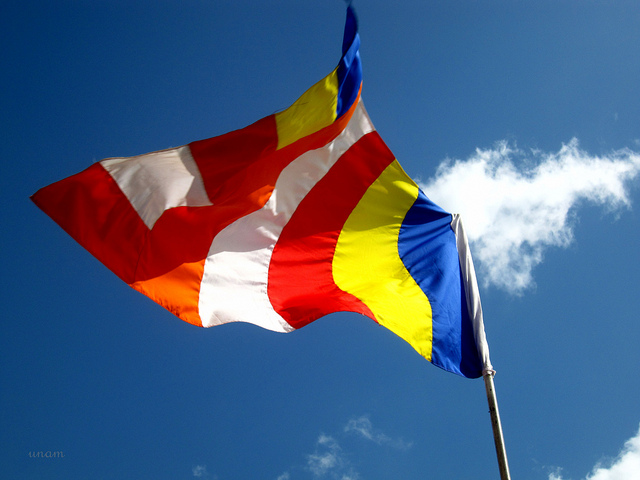
 The six vertical bands of the flag represent the six colors of the aura which Buddhists believe emanated from the body of the Buddha when he attained Enlightenment:
Colours
Blue (Nīla): Loving kindness, peace and universal compassion
Yellow (Pīta): The Middle Path – avoiding extremes, emptiness
Red (Lohita): The blessings of practice – achievement, wisdom, virtue, fortune and dignity
White (Odāta): The purity of Dharma – leading to liberation, outside of time or space
Orange (Manjesta): The Buddha's teachings – wisdom
The Buddhist flag is a flag designed in the late 19th century to symbolise and universally represent Buddhism. It is used by Buddhists throughout the world.
History
The flag was originally designed in 1885 by the Colombo Committee, in Colombo, Sri Lanka. The committee consisted of Ven. Hikkaduwe Sri Sumangala Thera (chairman), Ven. Migettuwatte Gunananda Thera, Don Carolis Hewavitharana (father of Anagarika Dharmapala), Andiris Perera Dharmagunawardhana (maternal grandfather of Anagarika Dharmapala), Charles A. de Silva, Peter De Abrew, William De Abrew (father of Peter), H. William Fernando, N. S. Fernando and Carolis Pujitha Gunawardena (secretary).
This flag was published in the Sarasavi Sandaresa newspaper of 17 April 1885 and was first hoisted in public on Vesak day, 28 April 1885 at the Dipaduttamarama, Kotahena, by Ven. Migettuwatte Gunananda Thera. This was the first Vesak public holiday under British rule.
Colonel Henry Steel Olcott, an American journalist, founder and first president of the Theosophical Society, felt that its long streaming shape made it inconvenient for general use. He therefore suggested modifying it so that it was the size and shape of national flags. Modifications were made accordingly, which were adopted. The modified flag was published in the Sarasavi Sandaresa of 8 April 1886 and first hoisted on Vesak day 1886.
In 1889 the modified flag was introduced to Japan by Anagarika Dharmapala and Olcott—who presented it to the Emperor—and subsequently to Burma.
At the inaugural conference of the World Fellowship of Buddhists on 25 May 1950, its founder President Professor G P Malasekera proposed that this flag be adopted as the flag of Buddhists throughout the world; this motion was unanimously passed.
Variants
However, some choose to change the colors of the flag to emphasize their own teachings.
In Japan, there is a traditional Buddhist flag (五色幕—goshikimaku) which has different colors but is sometimes merged with the design of the international flag to represent international cooperation. The five colors of the Japanese Buddhist flag represent the Five Wisdom Buddhas, or alternately the colors of the Buddha's hair.
The Jodo Shinshu sect in Japan replaces the orange stripe with pink.
In Tibet, the colours of the stripes represent the different colours of Buddhist robes united in one banner. Tibetan monastic robes are maroon, so the orange stripes in the original design are often replaced with maroon.
Tibetan Buddhists in Nepal replace the orange stripes with plum stripes.
Soka Gakkai uses a tricolor of blue, yellow, and red.
Theravada Buddhists in Burma replace orange with pink,
the color of the robe of the country's nuns.
Theravada Buddhists in Thailand opt the usage of a yellow flag with a red Dharmacakra; it is sometimes paired with the international Buddhist flag.
2835 lượt xem
Tin khác

THÔNG ĐIỆP VESAK 2022 của Tổng Thư Ký Liên Hiệp Quốc Tôi xin gửi lời chúc mừng nồng nhiệt nhất đến tất cả những ai đang hướng về kỷ niệm…

Pháp thoại CẢM NIỆM VÀ Ý NGHĨA CÚNG DƯỜNG PHẬT ĐẢN PHẬT LỊCH 2562 Tỷ Khưu THÍCH THÁI HÒA NAM MÔ BỔN SƯ THÍCH CA MÂU NI PHẬT Phật…


